2 Family History and Birth
From Baden-Württemberg to Volhynia
The story of the Rapp family begins not in the German colonies of Volhynia, but in the small towns of Baden-Württemberg in southwestern Germany. The Rapp family came from the area around Nagold, in the Black Forest foothills — Ewald’s great-grandfather Jakob Friedrich Rapp was born there. The Kälbert family can be traced to Öschelbronn, a village nearby (TODO TODO). These were modest farming communities, and for generations, the families worked the land as it had always been worked.
But the upheavals of the late 18th and early 19th centuries — the devastation of the Napoleonic Wars, the chronic scarcity of land in the densely settled German southwest, and the grinding poverty that came with too many heirs dividing too few acres — drove families to look eastward. The Austrian Empress Maria Theresa and later the Russian Tsars offered land and religious freedom to settlers willing to tame the vast, underpopulated territories of Eastern Europe. For families like the Rapps and Kälberts, it was an offer born of desperation and hope in equal measure.
The Kälbert family’s emigration is documented in some detail. In May 1803, the baker and farmer Johann Georg Kälber and his wife Barbara Knapp left Öschelbronn with nine children — their two oldest sons having already departed the previous December. Johann Georg was among the more prosperous families in the village, and upon arrival near Płock in central Poland he received a farm of 90 to 120 Morgen (roughly 22 to 33 hectares). The Rapp family made the same journey eastward from Nagold, though the exact date of their departure is not recorded.
In Poland, the German settlers established colonies where they could farm and worship freely. It was here, in the villages around Iłów in the Płock region, that the Rapp and Kälbert families eventually crossed paths. Georg Rapp — born around 1836 in Kochanów, the son of the labourer Jakob Rapp and Anna Maria née Binder — married Marianna Kelber on November 11, 1860 in the Evangelical-Augsburg (Lutheran) Church in Iłów. Marianna was 22, the daughter of the mason Adam Kelber and Katharina née Ritter. Both Georg and Marianna were living in the nearby village of Rybionki at the time of their marriage. The church record notes that neither could write — they were simple farming people, and the witnesses signed on their behalf.
Shortly after the wedding, Georg and Marianna appear to have spent time in Warsaw, where their daughter Karolina was baptized on April 28, 1861. But after a generation in Poland, the familiar problem reasserted itself — the fields were too small for large families, and opportunity was scarce. In the 1870s, a wave of these German-Polish settlers moved further northeast, into Volhynia — the gently rolling, forested land of northwestern Ukraine, then part of the Russian Empire.
Georg and Marianna Rapp were among them. They settled in the Heimtal area, in the cluster of German colonies northwest of Zhytomyr. The German settlers made the land usable — clearing forests, draining the extensive swamps, and establishing farms on the rich black soil. By the turn of the century, some 160,000 Germans lived in Volhynia, forming close-knit communities organized around their churches. The family had been Lutheran when they married in Iłów, but sometime in the 1890s — likely influenced by the vibrant Baptist congregations taking root in the German colonies — they converted to the Baptist faith. Their son Michael Josef Rapp was born on March 2, 1880 in the village of Janowka.
Michael married Amalie Welke on November 29, 1901 in the Free Church German Baptist Chapel at Sorotschin, one of the earliest Baptist congregations in all of Ukraine. They built a life as farmers, and their children were born across several of the German colonies: Julius in Hanapoli (1903), Ludwig in Janufke (1907), and Ewald on April 1, 1912 in Alexandrov bei Mirow. As Ewald later recalled, his parents worked hard to clear land overgrown with shrubs six feet high, cultivating wheat, rye, and other grains. His mother Amalie managed the household, worked in the fields alongside Michael, and handled the family’s business affairs. Life was modest — cities were almost a full day’s travel by dirt road — but the land was fertile and the rain was reliable.
The Germans were respected as industrious farmers who brought progress to the land. They lived simply but peacefully alongside Ukrainians, Poles, and other settlers. But this peace would not last. In 1914, the German Kaiser declared war on Russia, and for the German colonists of Volhynia, the world they had built over two generations began to collapse.
2.1 Iłów Marriage Record, 1860
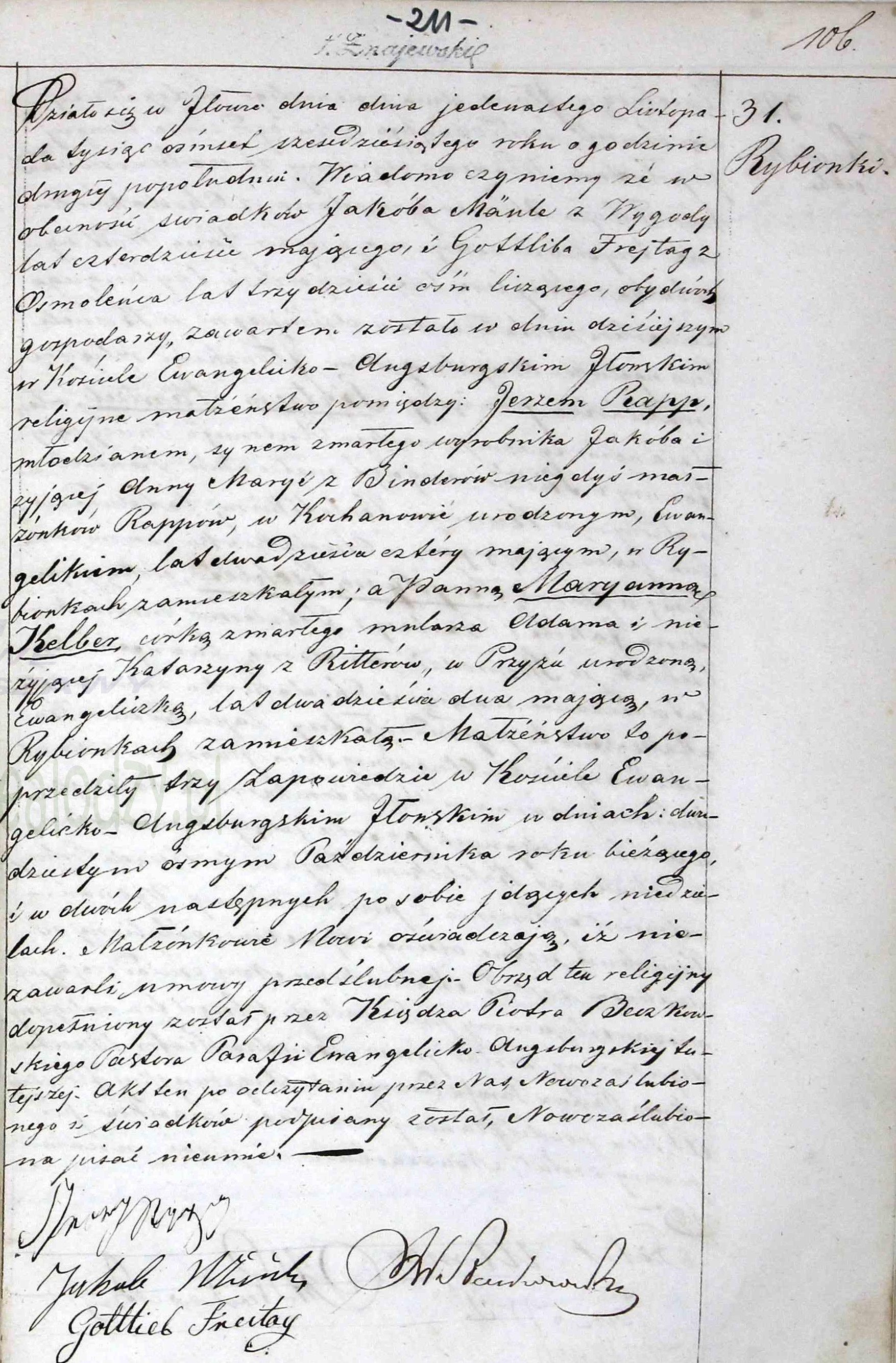
The earliest surviving document of the Rapp family is the marriage record of Georg Rapp and Marianna Kelber, found in the digitized church books of the Evangelical-Augsburg Parish in Iłów, Poland (Digitized Church Books of the Iłów Evangelical-Augsburg Parish, n.d.) by researcher Hendrik Wendland. Written in Polish — the official language for civil records in Congress Poland under Russian rule — it documents the wedding of Ewald’s paternal grandparents and provides the earliest confirmed details of both the Rapp and Kälbert family lines.
2.1.1 Transcription (Polish)
Pisało się w Iłowie dnia jedenastego Listopada tysiąc ośmset
sześćdziesiątego roku o godzinie drugiej popołudniu. Wiadomo
czynimy że w przytomności świadków Jakóba Mänle z Wygody
lat czterdzieści mającego i Gottlieb Freitag z Osmolina lat
trzydzieści ośm liczącego obydwóch rolników zawartem zostało
w dniu dzisiejszym w Kościele Ewangelicko-Augsburskim Iłowskim
religijne małżeństwo pomiędzy: Jerzym Rapp, młodzianem, synem
zmarłego robotnika Jakóba i żyjącej Anny Maryi z Binderów
niegdyś małżonków Rappów, w Kochanowie urodzonym,
Ewangelikiem lat dwadzieścia cztery mającym, w Rybionkach
zamieszkałym; a Panną Maryanną Kelber, córką zmarłego
murarza Adama a nieżyjącej Katarzyny z Ritterów, w Przydze
urodzoną Ewangeliczką lat dwadzieścia dwa mającą, w
Rybionkach zamieszkałą — Małżeństwo to poprzedziły trzy
Zapowiedzi w Kościele Ewangelicko-Augsburskim Iłowskim
w dniach dwudziestym ósmym Października roku bieżącego
i w dwóch następnych po sobie idących niedzielach a na
Małżeństwo nikt oświadczył iż przeszkoda nie zaszedł. Obrzęd
ten religijny dopełnił Pasterz Piotr Beczkiwski Parafii
Ewangelicko Augsburskiej Iłowskiej. Akt ten po przeczytaniu
przez nas nowożaślubionemy i świadkom tego nie podpisano
gdyż nowozaślubieni pisać nie umieją.
2.1.2 Translation
This translation was provided by Hendrik Wendland. Note that the Polish record gives the groom’s name as Jerzym Rapp — Jerzy being the Polish equivalent of the German name Georg. Michael Rapp’s 1948 affidavit confirms his father’s name as Georg (written “George”), and we use the German form throughout the narrative.
Married in Iłów on 11th November 1860, 2 o’clock in the afternoon.
Witnesses: Jakob Mänle from Wygoda, 40 years old, and Gottlieb Freitag from Osmolin, 38 years old, both farmers.
Groom: Georg Rapp, young man, son of the deceased labourer Jakob and the living Anna Maria née Binder, once married couple Rapp, born in Kochanów, 24 years old, residing in Rybionki.
Bride: Miss Marianna Kelber, daughter of the deceased mason Adam and the deceased Katharina née Ritter, born in Przyzie, 22 years old, residing in Rybionki.
The marriage was preceded by the announcement of three banns on 28th October and the following two Sundays.
The newlyweds confirmed that they had no prenuptial agreement.
Married by Pastor Piotr Beczkiwski, Iłów Evangelical Augsburg Parish.
This record was read out to the newlyweds and witnesses and signed by the witnesses only, as the newlyweds confirmed that they are unable to write.
2.2 Marriage Affidavit, 1948
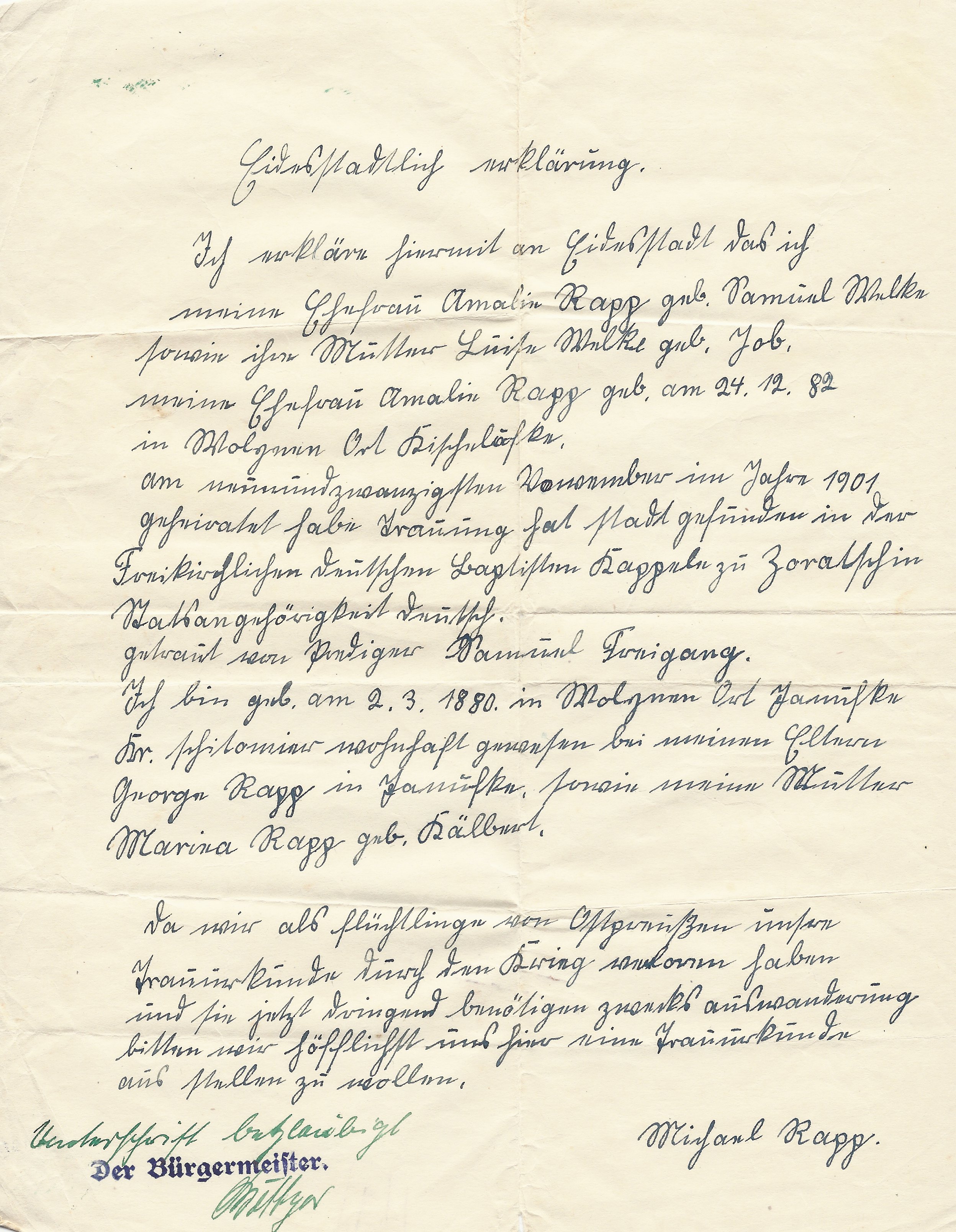
Nearly a century later, the family’s paper trail had been all but destroyed. As Michael and Amalie were preparing to emigrate from West Germany to the United States in the late 1940s, they needed to provide a marriage certificate — but theirs had been lost during their years as refugees in World War I and World War II. In its place, Michael wrote a sworn affidavit. This remarkable document, with its careful, formal German, is one of the few surviving records that ties the Rapp family to specific places and dates in Volhynia.
2.2.1 Transcription
Eidestadtlich erklärung

Ich erkläre hiermit an Eidesstadt das ich
meine Ehefrau Amalie Rapp geb. Samuel Welke
sowie ihre Mutter Luisa Welke geb. Job,
meine Ehefrau Amalie Rapp geb. am 24.12.82.
in Wolynen ort Kischelüfke
an neunundzwanzigsten November in Jahre 1901
geheiratet habe Trauung hat stadt gefunden in der
Freikirchlichen Deutschen Baptisten Kappelle zu Zoratschin
Stattangehörigkeit Deutsch.
getraut von Prediger Samuel Freigang.
Ich bin geb. am 2.3.1880 in Wolynen Ort Janufke
Kr. Schitomier wohnhaft gewesen bei meinem Eltern
George Rapp in Janufke sowie meinen Mutter
Mariea Rapp geb. Kälbert.

Da wir als Flüchtlinge von Ostprueßen unser
Trauurkunde durch den Krieg verloren haben
und sie jetzt dringend benötigen zwecks auswanderung
bitten wir höfflichst uns hier eine Trauurkunde
aus stellen zu wollen.

Unterschrift beglaubigt         Michael Rapp
Der Bürgermeister
Wittger
2.2.2 Translation
This translation was made by Daniel Rapp with assistance from Mikayla Robbins
Statement Under Oath
I declare under oath the following. My wife, Amalie Rapp with parents Samuel Welke and Luisa Welke nee Job was born on 24 December 1882 in Volynia in Kiseljowka. On the 29th of November in 1901 we were married in the German Baptist Free-church in the Sorotschen chapel (German nationality). The marriage was performed by Pastor Samuel Freigang. I was born on 2 March 1880 in Volynia, in the village of Janowka in the district of Zhytomyr. My place of residence was with my parents, Georg Rapp and Mariea Kälbert in Janowka.
As we are refugees from East Prussia, we lost our marriage certificate in the war. We are in desperate need of a replacement due to emigration. We kindly request a replacement.
Signed by Michael Rapp
Notarized by the Mayor, Wittger